
No Title
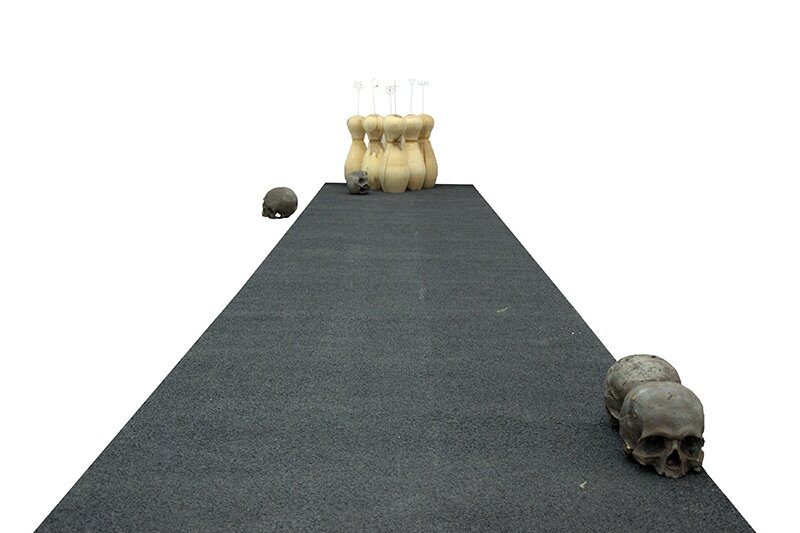
700 x 120 x 70 cm
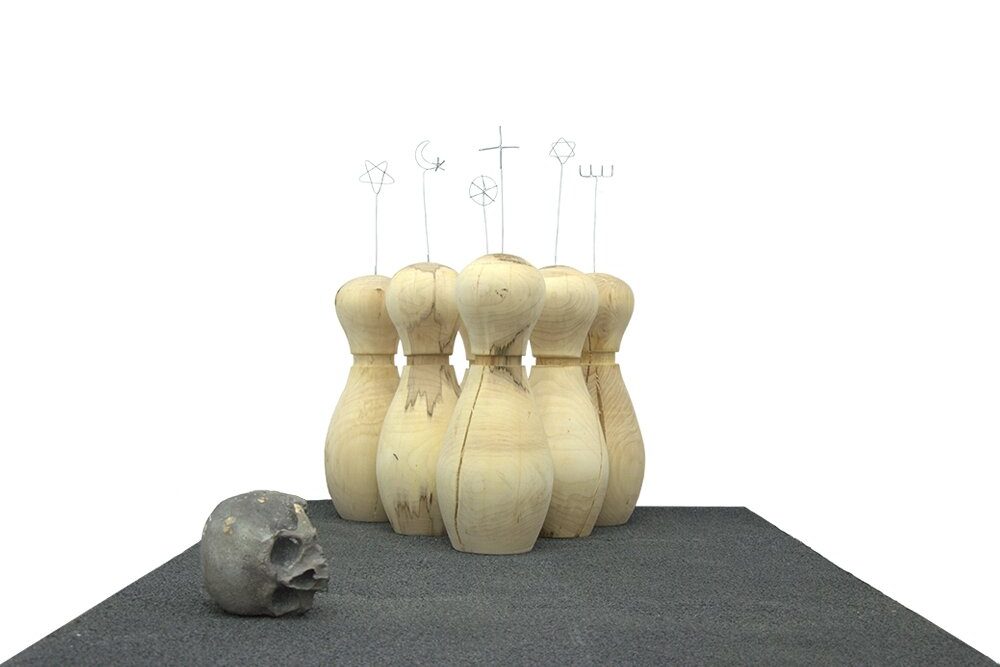
bronze, wood, copper, roof felt
2012, Warsaw, Poland
Never before has knowledge extended across such a vast territory. We observe processes taking place inside the cell, intervene in genetic material, leave the Earth’s atmosphere and reach places where the human body cannot survive unaided. Fewer and fewer things remain invisible simply because they are too small, too distant or too complex.
Religion, too, has not remained beyond the reach of this knowledge. Its histories can be reconstructed, its texts dated, and its institutions described through their relations to power, property and economics. What for millennia was presented as originating beyond the world has left, within the world, an unusually legible archive of its own formation.
Yet none of this has made religion disappear.
Modernity repeatedly announced the moment when religion was expected to lose its position. Each new expansion of knowledge seemed to reduce the space available to transcendence. The Earth ceased to be the centre of the cosmos, creation gave way to evolution, illness ceased to be punishment, lightning a message, and heaven a kingdom. Religions learned to survive the loss of one territory after another.
Understanding a mechanism does not necessarily lead to stepping outside it. One can know the genealogy of a ritual and still perform it. One can recognise the historical character of an institution and still grant it a particular authority. Knowledge and faith do not always occupy opposite ends of the same axis. Sometimes they coexist, without much difficulty, in the same head.
Perhaps that is precisely why a head filled to capacity becomes such an ambiguous object.
The more it weighs, the more energy it carries. The same weight that increases the force of impact also makes the throw harder to execute. Accumulated knowledge does not produce a proportional increase in effectiveness. One can command an ever weightier argument and still miss.
Religions have survived successive systems of knowledge and critique that were supposed to render them historically obsolete. Each provided new reasons to see them as historical constructions.
Each made the head heavier.
Religion can lose its monopoly on explaining the world without losing its capacity to organise the lives of people who already know that the world can be explained otherwise.
It is therefore not certain that ignorance remains reason’s adversary. Far more resilient are structures capable of continuing to function after the necessity that produced them has disappeared.
Roofing felt stretches between these orders. One of the least metaphysical materials imaginable: a technical membrane placed exactly where architecture meets the sky.
Heaven ceased to be an address long ago.
The throw remains.