
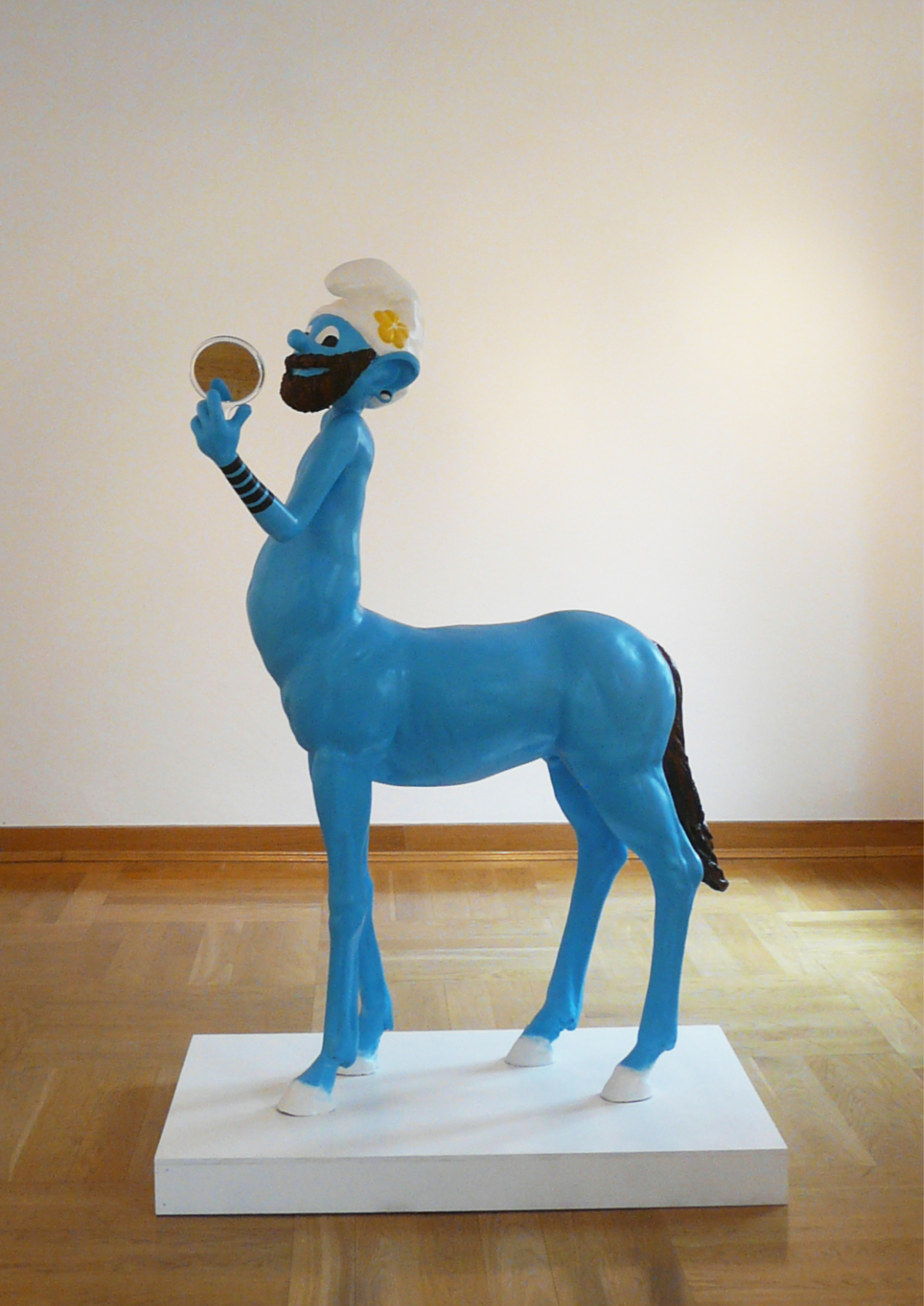
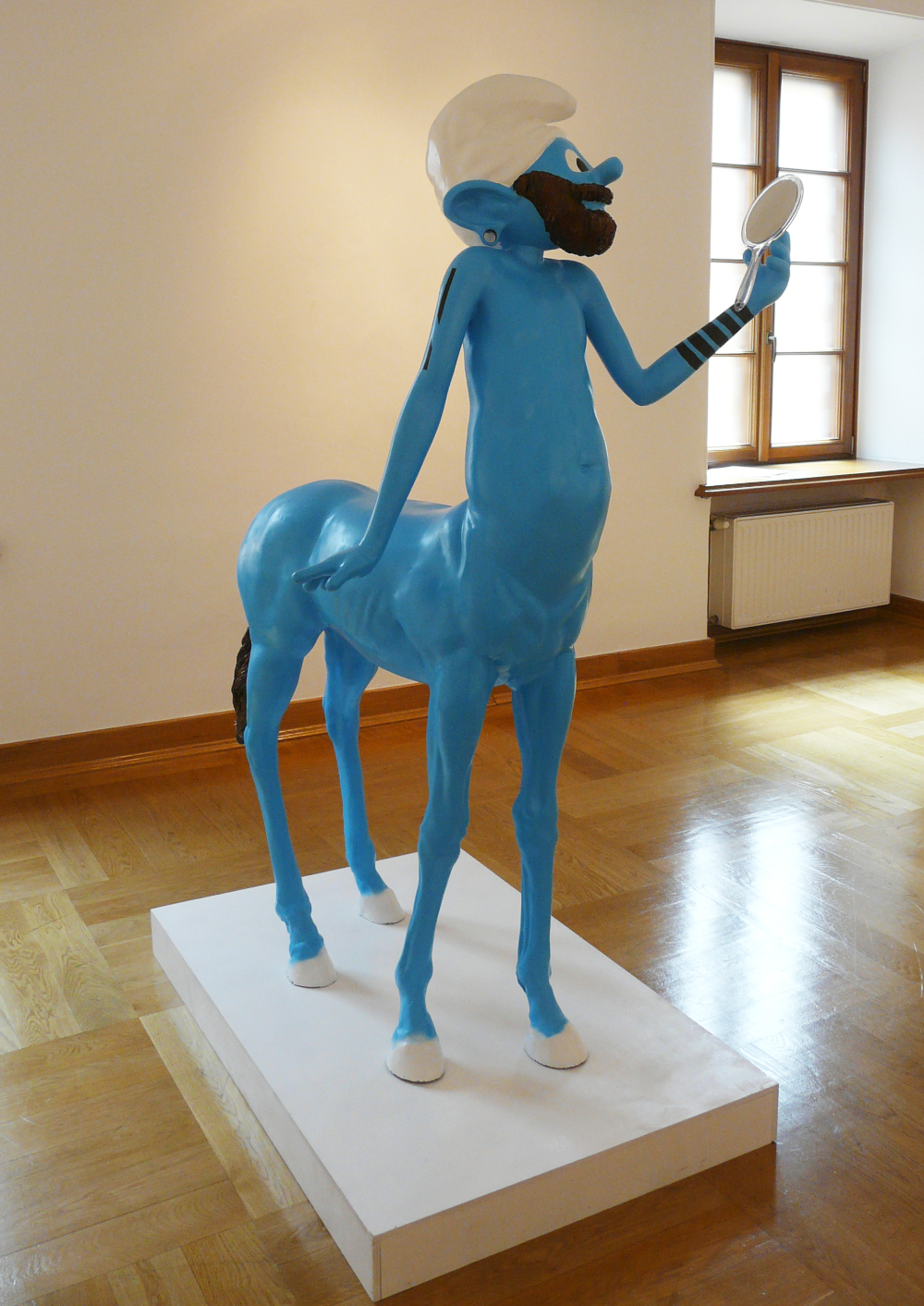
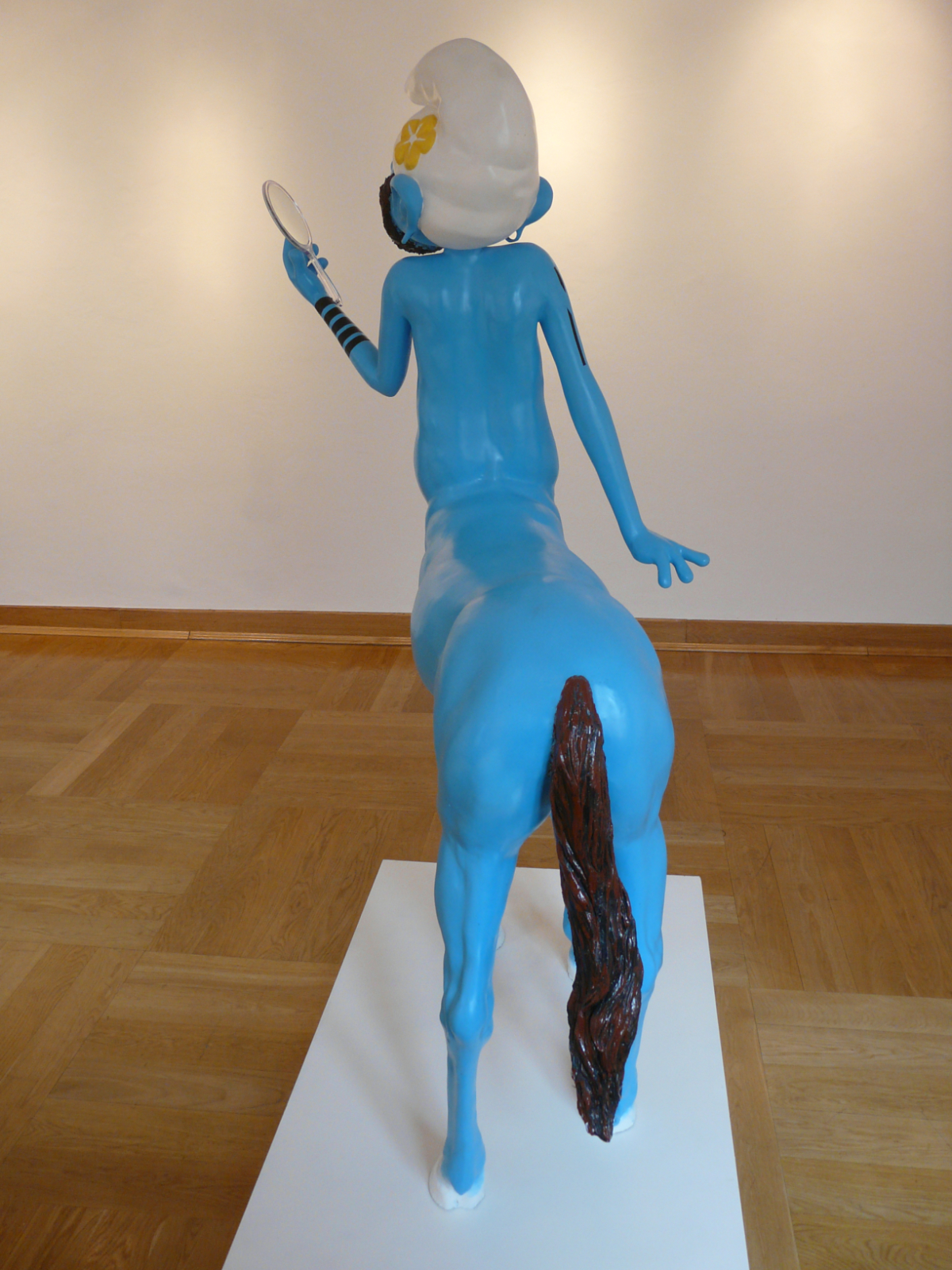
Mr Trendy
200 x 120 x 130 cm
synthetic resin, mirror, wood
2015, Warsaw, Poland
Difference begins to produce sameness the moment it becomes a recognisable code.
The need to stand out depends on signs that can be read — and therefore repeated, appropriated and reproduced. To become socially legible, difference must speak a shared language.
The monumental Smurfaur — a hybrid of a Smurf and a centaur — pushes this paradox to grotesque excess. Its body is loaded with accumulated attributes of distinction: signs meant to establish and communicate uniqueness. Their force lies not in being unique, but in being recognisable. What is supposed to set the individual apart must already belong to a repertoire of meanings capable of confirming that difference.
The sculpture does not illustrate this mechanism — it is built according to its logic. The Smurf is almost a laboratory model for the production of individuality: a single body is replicated, and a minimal modification is enough to produce a “person”. A name, a trait, a hairstyle or a single attribute is enough for nearly identical figures to function as distinct personalities. In the sculpture, this principle is scaled up, compounded and pushed to absurdity: uniqueness has to be signalled ever more conspicuously.
A style, gesture, object or way of constructing one’s image may function as a declaration of independence, belonging or rebellion, yet the more effectively it operates as a sign of distinction, the faster it is reproduced — until difference collapses into its own caricature. The sign that once allowed someone to stand out begins to identify a group.
The satire is not aimed at the desire for difference itself, but at a culture that has turned uniqueness into an imperative of self-presentation, then supplies ready-made ways of fulfilling it. Mass-reproduced uniqueness becomes its own caricature.
The market did not create the need for difference. It learned to recognise it, capture it and put it back into circulation. Signs that emerge as expressions of distinction are identified, codified and returned as products, styles and components from which to assemble a self. Their proliferation strips them of their power to distinguish, creating demand for the next. The market feeds both on the desire for uniqueness and on the continual exhaustion of its signs.
Within this circulation, the individual becomes both a product of the system and a market for its producers. The individual consumes the means of their own uniqueness, while the need to continually reaffirm difference drives the production of new signs.
The mirror adds another level to this construction: uniqueness is not enough unless it is seen and confirmed.
A useful reference here is “The Emperor’s New Clothes”. Andersen’s tale exposes how the value attached to an image can be collectively sustained. What is admired as desirable or exceptional need not possess those qualities in itself; recognition, imitation and mutual confirmation can manufacture the value they appear merely to acknowledge.
Since the work was made, the signs, technologies and speed of their reproduction have changed. The mechanism has remained remarkably stable — and has even acquired new tools and less visible ways of operating.
Generative artificial intelligence introduces another variable into this equation. Technology does not merely provide tools of expression; it can actively participate in shaping the language, image and form through which the individual presents themselves.
The technological filter no longer needs to give itself away through error. Increasingly, it operates through the appearance of competence: fluency, correctness and persuasive form that can mask the process by which individual intention is normalised to fit pre-existing patterns.
The variables change, not the equation.