Shreds
400 x 130 x 100 cm
wood, metal
2011, Warsaw, Poland
Form is produced through removal. In subtractive sculpture, this creates a fundamental ambiguity: the act of forming is also an act of destruction, yet the relation can equally be reversed — an act of destruction can itself be understood as an act of forming. Every cut establishes a boundary between what is retained as form and what is excluded from it. A single decision simultaneously produces the artwork and its waste. In this sense, every subtractive sculpture generates its own invisible negative — the material mass of everything it had to cease being in order to assume a particular form.
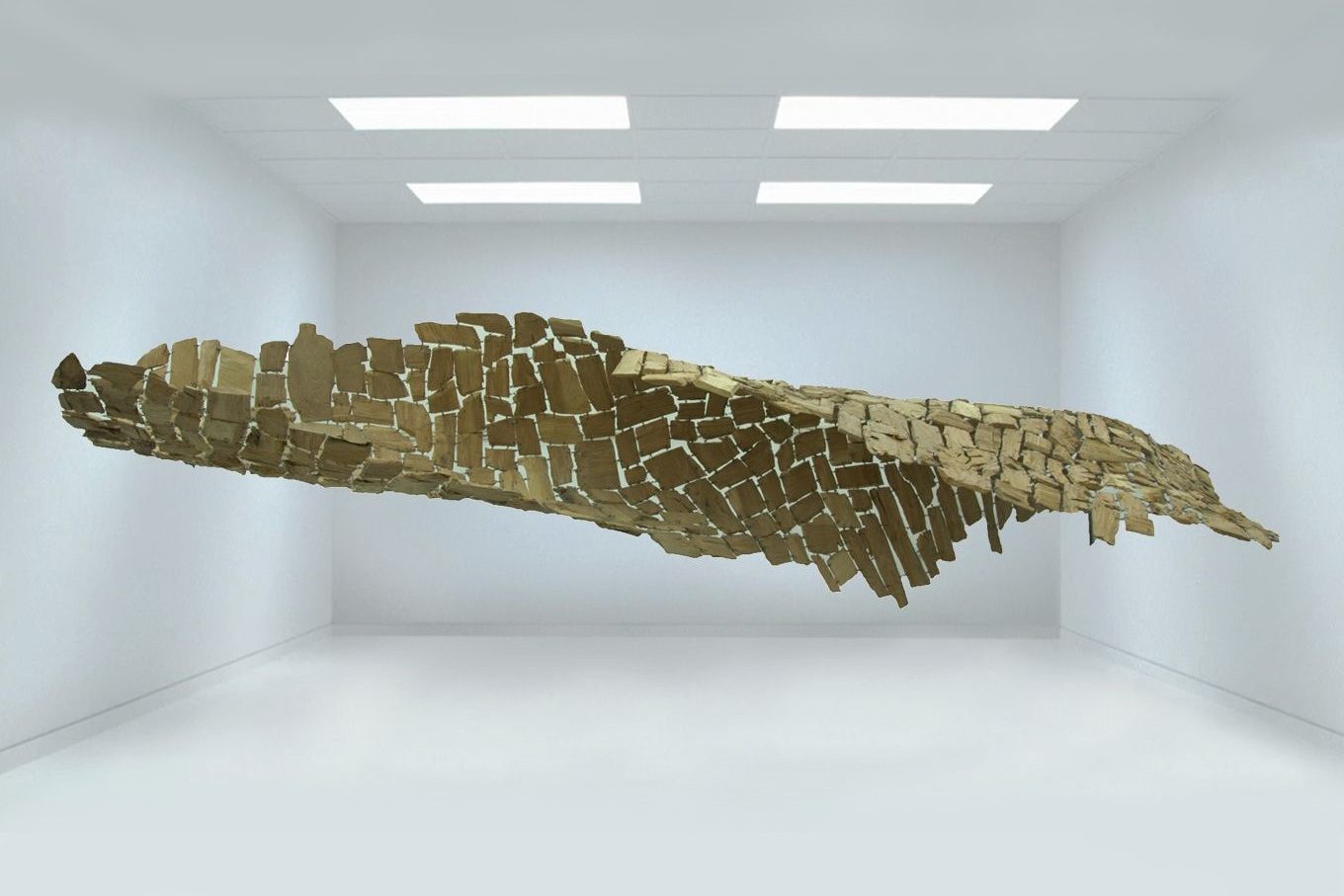
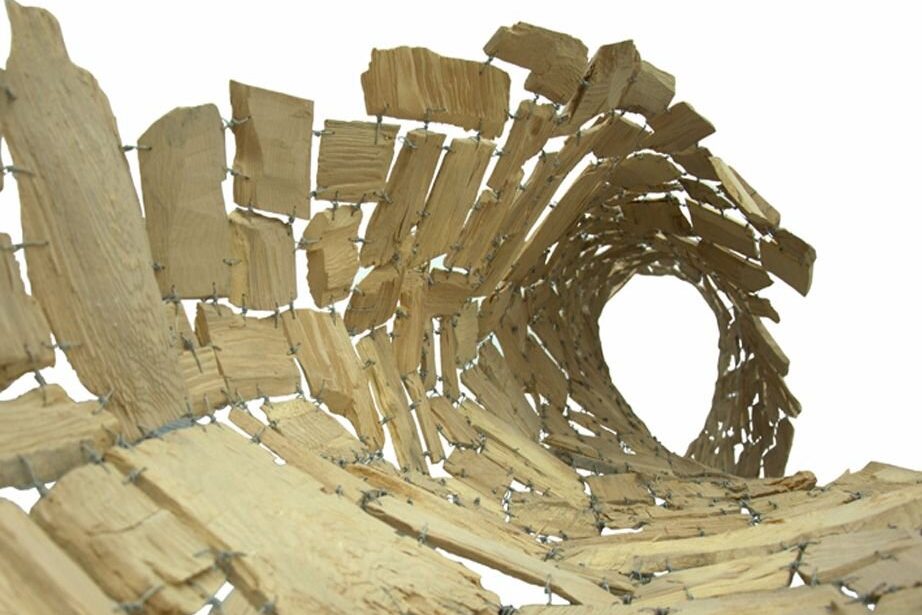
The work is made from fragments of wood — waste produced by ten sculptors as they shaped freshly cut tree trunks with axes. The fragments were collected and painstakingly stitched into a single structure; each piece was repeatedly drilled and wired to those around it. The logic of the original process is reversed: cutting, separation and dispersal give way to gathering, joining and consolidation. The resulting form does not reconstruct any previous whole. It retains the marks of cutting, fracture and rejection — consolidation does not erase the history of disintegration.
A fragment of wood does not become waste because its material properties have changed, but because it no longer belongs to the intended form. Waste is therefore not a property of matter, but a status assigned through a decision.Shreds gathers the material consequences of multiple independent formal decisions. It does not reverse those decisions, but changes the status of what they rejected.
What the original sculptural process established as form disappears from view, while what it relegated to the status of the insignificant and disposable becomes the sole visible material of a new work. Shreds does not so much transform waste into art as reveal that “artwork” and “waste” are two statuses produced by the same act of selection.