
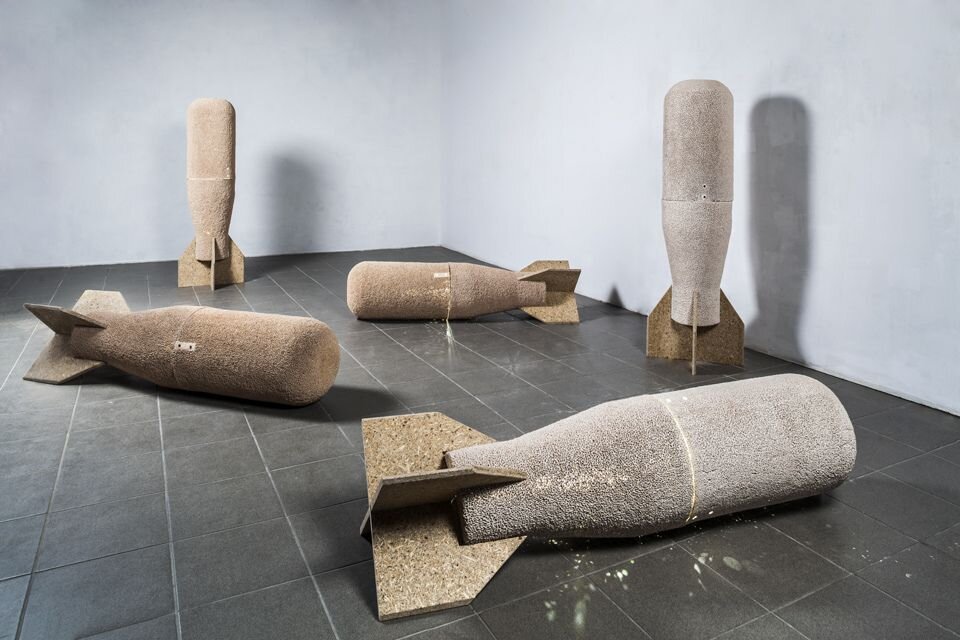

Return to Eden
150 x 45 x 45 cm each element
ceramic, wood, electronic components
2013, Warsaw, Poland
Human intelligence most often legitimises itself through efficacy. It enables us to anticipate, calculate, isolate relationships and turn them into instruments. Each successive degree of control over matter reinforces the conviction that knowledge expands the margin of safety.
The splitting of the atom complicates this order. The cognitive achievement does not fail; on the contrary, it operates with exceptional precision. The problem emerges only at the level of use. Reason can attain its highest degree of technical effectiveness precisely where it is deployed against the conditions of its own continuation.
This is what makes the atomic bomb a singular case. It is neither a simple negation of progress nor an external distortion of it. It emerges from within the same logic that enables advances in medicine, energy, transport and communication: an increasingly precise understanding of the world and an increasingly effective capacity to intervene in its structure. The difference is that here effectiveness no longer leads simply to an expansion of human possibility. It also encompasses the possibility of its definitive curtailment.
“Little Boy” introduces into this relation the moment at which technical capacity ceases to be hypothetical. Hiroshima marks the historical point at which something was actualised that can no longer be returned to the realm of imagination. Knowledge, once converted into a capacity for action, does not recover its innocence.
Hundreds of thousands of perforations preserve the trace of an individual gesture, yet their accumulation makes it impossible to sustain that individuality. Light passes through them as though a technology of self-annihilation had been forced to shine through the consequences of its own operation.
Within this feedback loop, the boundary between dominance and its loss begins to collapse. The same capacity that establishes human mastery over matter produces the means capable of ending that mastery. Human intelligence begins to resemble a system equipped with its own critical error — not as the opposite of its efficiency, but as one of its possible consequences.
Only here does the title reveal the full extent of its irony.
Eden ceases to signify a lost beginning to which one might return. It becomes a state that may emerge once humanity is no longer able to sustain the position it assigned itself. It does not require our presence. It need not even preserve the memory of our dominance.
The most advanced capacity to subordinate the world may therefore prepare the conditions in which the world is no longer subordinate to anyone.
It is not humanity that returns to Eden.
Eden returns after humanity..