
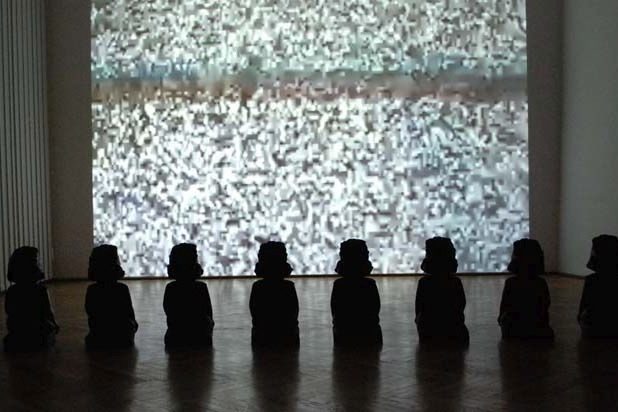
Two Thousand and Twelve
450 x 250 x 300 cm
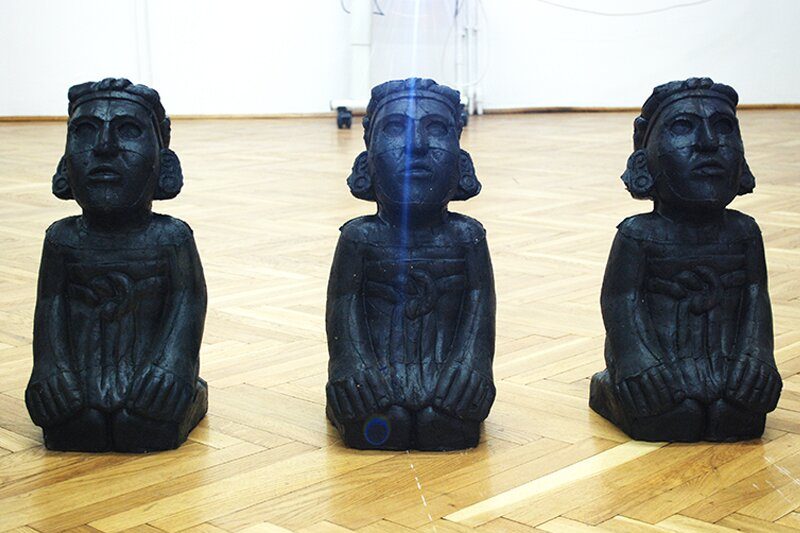
polychrome ceramic, video
2010 Toruń, Poland
tzuhtzjoom u(y)-uxlajun pik
(ta) 4 Ajaw 3 Uniw
uhtoom ili yeen-balun-yokte’
ta chak joy(-aj)
“It will be closed the 13th Bak’tun (on) 4 Ajaw 3 Kank’in. It will happen this Balun-Yokte’-display in the great investiture.”
Excerpt from the inscription on Monument 6 at Tortuguero. Transcription and English translation by Sven Gronemeyer and Barbara MacLeod (2011). The reading of the damaged final passage remains subject to scholarly debate.
For centuries, this inscription remained part of the history of the civilisation that produced it. At the beginning of the twenty-first century, it became one of the reference points for visions of a global catastrophe expected to occur on 21 December 2012. The date marking the completion of the thirteenth Bak’tun in the Maya calendar was invested with a meaning absent from the original text. A historical inscription was transformed into a prophecy, which in turn came to be regarded as evidence of an impending event.
This process involved a peculiar reversal of the relationship between knowledge and belief. Rather than emerging from an understanding of the source, interpretation began to determine how the source itself was read. What remained unknown no longer required explanation; it was enough to assign it a meaning. The authority of an ancient civilisation came to validate beliefs that had emerged long after its decline.
It is telling that modern humanity devised its own vision of annihilation, attributed it to a distant culture, and then began to fear it as though it existed independently of its own imagination. What it had imagined returned in the form of an external threat — endowed with a date, the authority of the past, and an air of inevitability.
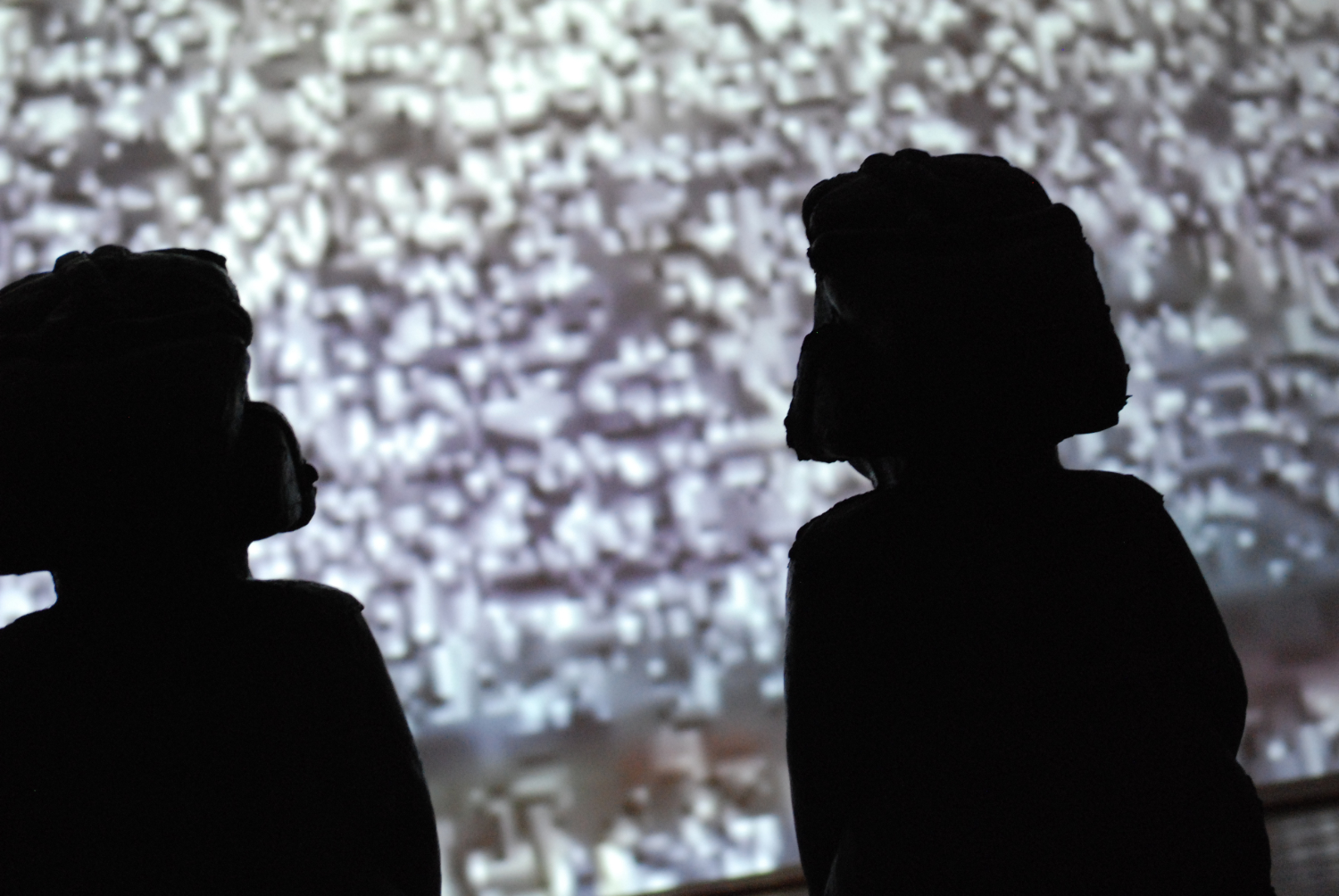
Two Thousand and Twelve reverses this relationship. The pre-Columbian past is confronted with a future imagined in its name. In place of the anticipated revelation, there is cosmic noise — a void, an abyss, an image devoid of any message. Before it, the figures remain, as though observing contemporary fear from a perspective far older than the prophecy itself.
Yet the absence of a message does not necessarily bring expectation to an end. On the contrary, it may give rise to further interpretations. Where no answer exists, human beings are capable of inventing one, only to forget that it was of their own making. Ignorance thus ceases to be a condition calling for understanding and becomes a space into which almost any conviction can be projected.
Apocalyptic visions reveal a deeper contradiction. While foretelling humanity’s ultimate destruction, they simultaneously reinforce its belief in a privileged position within the universe. The catastrophe is assigned a time, a cause and a meaning. Even the extinction of humanity is incorporated into an order of events in which human beings remain the central protagonists.
The imagined end of the world may therefore, paradoxically, offer a form of consolation. It presupposes that human existence is of such importance that even its extinction constitutes an event of cosmic significance.
Far more difficult to accept is the possibility that the universe has no particular ending in store for us, sends us no message and assigns no special significance to our existence.
Human beings may come to terms even with the prospect of their own annihilation, provided that it remains part of a narrative about themselves.
The void deprives them of even that possibility.