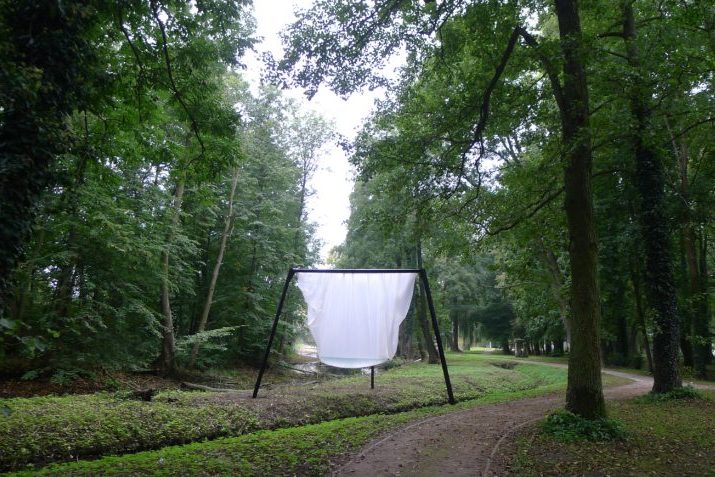
Other The Same
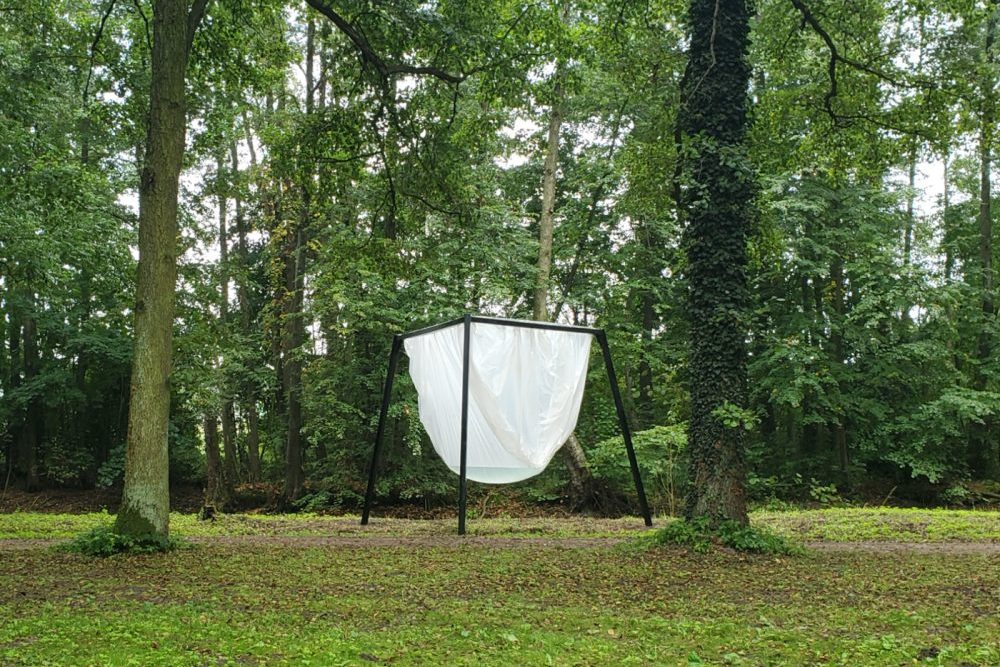
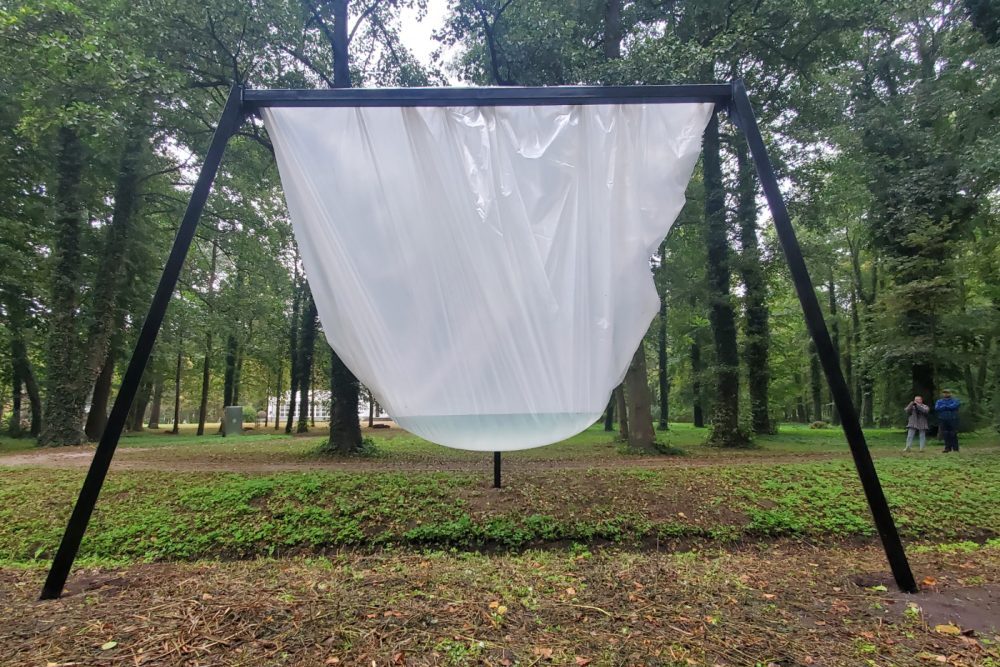
6 x 4 x 6 m
metal, plastic, water
2024, Centre of Polish Sculpture, Orońsko, Poland
Can something un-exist?
(Can something disappear itself?)
Every form can fall apart, its traces can be lost, and a thing can become utterly unlike what it once was. Yet the disappearance of a form does not mean the disappearance of the matter that constituted it. What ceases to be recognisable does not cease to participate in the world.
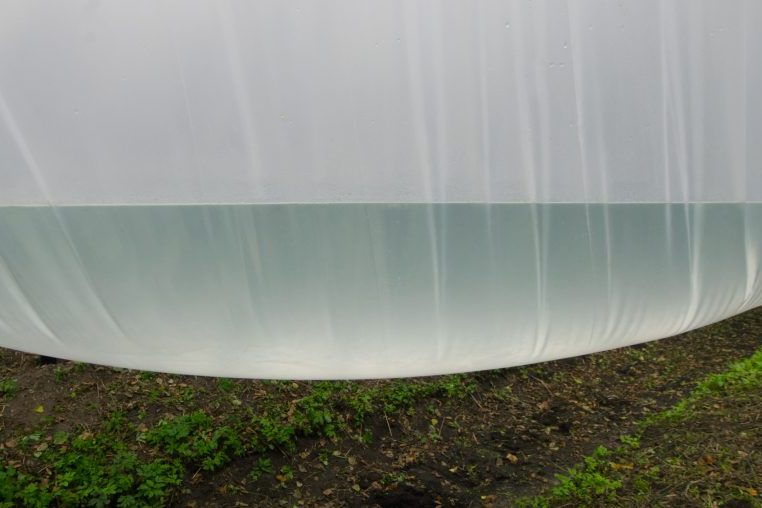
In Other the Same, water is enclosed within a transparent membrane. Human beings define the boundaries of the space it occupies, yet cannot fix it in any of the forms it takes. The water circulates, changes state, disappears from view and returns. What is inside does not cease to participate in what happens outside.
Containment makes visible the continuity of something no form can arrest.
The installation becomes a kind of keyhole through which we glimpse a reality on an unimaginably larger scale. Yet what we see is not a miniature of that reality, but an actual fragment of the processes unfolding all around us. The water circulating within the membrane is no different in nature from the water that fills a single-celled paramecium, makes up most of the human body or covers most of our planet.
What is part of a living organism today may once have belonged to an ocean, a cloud or a glacier. Matter’s present form reveals nothing of the history of incarnations through which it has passed. It need not. Its history does not end with any of them.
Over time, algae may develop in the enclosed water. Life, however, does not arrive from another order of existence. The boundary between the living and the non-living is not a boundary between two kinds of matter. They are different ways in which matter is organised, coexisting and interdependent.
The form we see represents only a fraction of the history of the matter that constitutes it. An object does not begin when it is given shape, nor does it end when that shape is lost.
And yet human beings continue trying to hold matter in the forms they give it. As though it were possible to arrest a single moment in the history of something that had existed for n units of time before us. As though we ourselves were not merely a brief episode in the history of that same matter.
The metal and the membrane that give the installation its visible form are no exception. Their apparent permanence comes from a different pace of transformation, not from immutability. There is no matter here that only gives form, and none that merely yields to it. Everything that makes up this structure participates in processes it did not set in motion and cannot stop.
Seen from this perspective, even what we call solid takes on a certain fluidity. No form exhausts the possibilities of the matter that constitutes it.
Other the Same does not present an isolated fragment of nature. It allows us to glimpse nature’s ceaseless transformations without separating them from the world in which they unfold. Even the boundary established to contain matter remains part of the same order.
Matter is not merely what dances.
It is also the music.